
Which books fly off the library shelves?

More than a century ago, Winston Churchill ordered a report to find out which books were the most popular among prisoners. An up-to-date survey produced very different results.
Which are the most-borrowed authors in prison libraries? With the help of the charity Give a Book, we surveyed librarians across 50 UK prisons and young offender institutions (YOIs) to find out the most popular authors to mark 2026 as the National Year of Reading.
The list, and the librarians’ remarks, make fascinating reading. No surprise that Lee Child is the way-out front winner – and how appropriate, as he is currently serving as the first Prison Reading Laureate. The top 10 is all fiction, apart from inspirational self-help author Rhonda Byrne. Not far behind her, in the top 20, are other self-help and advice authors: Robert Kiyosaki (What The Rich Teach their Kids About Money that the Poor and Middle Class Do Not!); L J Flanders (Cell Workout); Ant Middleton (The Wall: Smash Self-Doubt and Become the True You), and David Goggins (Can’t Hurt Me: Master Your Mind and Defy the Odds).
Going down the charts, comments from librarians included “Urban fiction is a trend falling off here,” and “Historical fiction used to be big, but that’s now dropped off.”
It turns out that fantasy is having a big moment; a relatively new phenomenon. The top 30 includes 10 fantasy authors. Anything in a series can be popular. Readers are in it for the long haul. Graphic novels and Manga titles do particularly well with younger readers. A librarian at a YOI acknowledged that these books “can be quite expensive, but we have a monthly book budget to spend on books and try to aim for a range of genres that will engage the young people. The boys look after the books in general so it is a good investment if the graphic novels and Manga get them reading and keep them occupied when they are in their rooms.”
More than a century ago, Winston Churchill was also interested in what prisoners were reading. He thought books had a part to play in “the reformative purposes of prison treatment”. In 1911, when he was home secretary, he commissioned a report to find out what was available in prisons. His committee talked to prison chaplains, who were at that time responsible for choosing and distributing books. They also talked to prisoners and “examined the books they were reading”. They ended their report with a list of prisoners’ favourite authors.
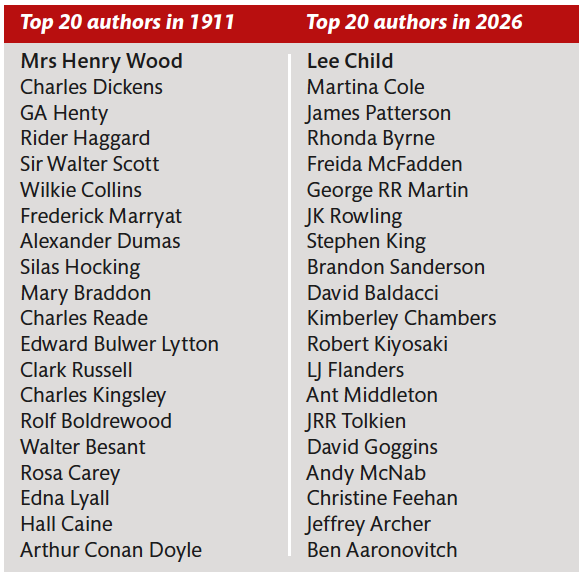
This list was all-fiction, and on the whole the committee approved. “The desire for books of fiction in prisons should be met, as now, in a liberal spirit,” the 1911 report concluded. Many of the authors on this list would need some reading stamina, but the committee were pleased to report good literacy rates. “The days when the bulk of prisoners were quite ignorant and illiterate are past,” they said.
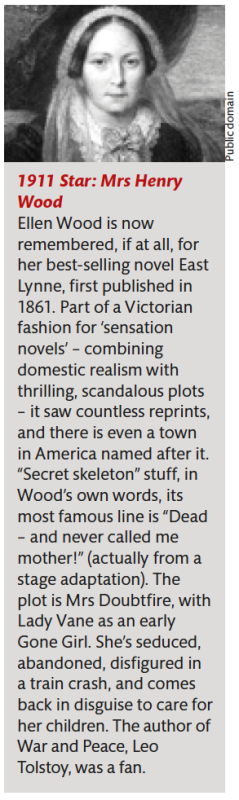
Just like the 2026 list, there’s a runaway winner at the top of the 1911 list: Ellen Wood, who wrote under the name Mrs Henry Wood. The best 2026 fit for her is probably Freida McFadden, popular in both men’s and women’s prisons. The opening sentence of McFadden’s bestseller, The Housemaid – “If I leave this house it will be in handcuffs” – is perfect Wood territory. Both authors favour twisty, melodramatic, psychological plots. McFadden is also as prolific as Wood, with eight titles in the Sunday Times bestselling books of 2025. Eight! The film of The Housemaid has been a box office success.

It’s notable that the two lists, compiled a century apart, share the same shape: a way-out-front author at the top, and a long tail at the other end. The 2026 list compiled from librarians has well over 100 favourite authors who got only one or two mentions. It’s a very long and varied list, showing that each library has its own flavour, its own identity.
This chimes with something noticed by the librarians in our survey, which is that “different books seem to go in and out of flavour”. (This is from a YOI). “There’ll be a rush on Young Adult series like the Cherub series by Robert Muchamore or series by Garth Nix or Darren Shan, then that interest will suddenly disappear.” The authors of the 1911 report would have recognized this. They noted “a curious fashion in books which occasionally springs up and runs through a prison”. They were pretty cynical about a Shakespeare craze at Dartmoor. They thought it was prisoners showing off, wanting to make “a show of great cultivation”.
I am less cynical, more hopeful, about what this says about reading in prison. These fashions, the books which spark wide interest in only one prison, suggest to me a world of book talk. People passing on recommendations, enjoying a shared pleasure. How else would Stephen Fry’s Greek myths series have made it on to the list at one prison, and then appear nowhere else? Or Machiavelli?
With thanks and admiration for the hard work and dedication of prison librarians across the UK. Prisons would be much poorer places without them.




Conditions of acceptance of website comments
Inside Time does not wish to apply censorship to comments posted on its website, however, we may remove posts if they have been flagged as inappropriate.You must not publish material that includes anything that:
- is considered to be offensive or includes inappropriate language
- may incite others to break the law
- identifies others by name, unless referring to the author of a previously published item
- includes unsubstantiated claims or hearsay but presented as fact
- includes personal opinions that are presented as fact
- includes discriminatory or derogatory comments about any person or section of society
- includes the alleged offences of named individuals unless it is considered to be already common public knowledge
All comments should address the original article or mailbag item and comments criticising other posters will not be posted unless they add something material to the original item.
Multiple postings under different names from the same IP address will not be posted and will be blocked from further posting.
Comments will be deleted if they contain foul language.
Inside Time reserve the right to republish comments in its newspaper or in any of its other publications, however, in these cases, comments will be anonymised.
The views and opinions expressed in comments are those of the authors and do not reflect the official policy or position Inside Time.