
Women’s Euros

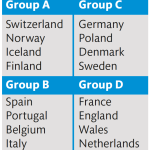 It is hard to believe that it’s now been three years since the England women’s football team lifted their first-ever UEFA trophy. The Lionesses, led by Dutch coach Serena Wiegman, who masterminded the success in 2022, are back to defend their title.
The 16-team tournament will run from 2 to 27 July and be hosted by Switzerland across eight venues, culminating with the final in Basel. Tune in to watch the best of the action with the TV coverage shared between the BBC and ITV. This is anticipated to be another competitive and dramatic tournament.
History
This will be the 14th edition of the UEFA Women’s Champ-ionship, first introduced in 1984. Then, only four teams competed for the trophy, and we saw Sweden defeat England in a two-legged final, 4-3 on penalties, at Luton Town’s Kenilworth Road. By the 1997 tournament in Norway, the format had increased to include eight teams. Today, following a surge in popularity of the sport in recent years, we have, for the third consecutive time, 16 teams competing.
Norway have been victorious twice, in 1987 and 1993, but the most successful team by some distance are the Germans, who have won the trophy eight times, including six in a row during their dominant period from 1997 to 2013.
The contenders
England (FIFA world ranking 4) – The magnitude of what the Lionesses achieved for women’s football, and indeed women’s sport, in 2022 is unprecedented. Not only did they make history, winning their first trophy by defeating Germany 2-1 in extra time of the final, but the FA later reported that over 461,000 extra opportunities were created to play, coach, officiate and volunteer across English schools and clubs. Across the nine host cities, 7,800 new girls and women registered to play in clubs. In the domestic seasons which followed, attendances increased in the Women’s Super League by 227 per cent and in the Women’s Championship by 87 per cent. Quite an impact!
The 2025 team will head into the tournament with high hopes and are likely to start as second favourites to Spain, the team that shattered their 2023 World Cup final dream. Wiegman will have them well-organised and motivated and can boast an incredible record of having led her teams to each of the last four European and World Cup finals, having previously managed her home nation, the Netherlands. England are boosted by the return of three key players, all back from knee injuries: the Manchester City duo of defender Alex Greenwood and forward Lauren Hemp, plus Bayern Munich’s attacking midfielder Georgia Stanway.
However, experienced goalkeeper Mary Earps announced her shock retirement just five weeks before the start of the tournament. The Lionesses will take confidence from Nations League home victories this year against Spain 1-0 and Belgium 5-0, as well as a 2-1 win in France.
Spain (2) – The current World Cup champions will head into the tournament as the bookies’ favourites to win their first European Championship. In 2022 they were knocked out by England at the quarter final stage, losing 2-1 in extra time, but they are a much stronger side this time. Their strength in midfield is unquestionable, with Aitana Bonmati who was voted the FIFA World Player of the Year in 2023 and 2024, lining up alongside her Barcelona teammate Alexia Putellas who herself won the award in 2021 and 2022. Spain won the first Nations League final against France 2-0 in February.
France (11) – The French are another team who have been improving in recent years and will be seeking to win their first European Championship. In 2022 they progressed to the semi-final stage, which was as far as they have ever been, losing 2-1 to Germany. Their squad will largely include players from Paris St Germain, which you would think would help, but progression to the knockout stage will not be easy considering they have been drawn in the ‘group of death’ which includes England and the Netherlands.
Germany (3) – You can never rule out the free-scoring mighty Germans in any major tournament and they also are in great form after Nations League wins this year against Austria 4-1 and Scotland twice, home and away, 6-1 and 4-0. German Player of the Year Giulia Gwinn is a consistent performer in midfield and her Bayern Munich teammate Lea Schüller has an impressive 49 goals in 73 appearances.
Wales make their first appearance in a major tournament after securing their place with a dramatic 2-1 victory over the Republic of Ireland. Along with Poland they will start as the rank outsiders. However, tournament football is full of unlikely upsets and literally anything can happen.
Sports Bites
Cycling
There will be 184 riders representing 23 teams from 5 to 27 July. First raced in 1903, the Tour de France is one of sport’s most gruelling tests of stamina and endurance, 21 stages comprising of seven flats, six hilly, six mountains plus two-time trials with only two rest days. Most stages are more than 170km with riders in the saddle for five to six hours per day. The overall round trip is 3,338km, eventually crossing the finish line down the Champs-Élysées in Paris. It is widely believed that the race will be between the 2024 tour champion, Slovenia’s Tadej Pogacar, and the 2023 champion, Jonas Vingegaard from Denmark
Golf
Teed up for 17 to 20 July is the 153rd Open Championship which this year takes place at the Royal Portrush Golf Club, set in the rolling hills of County Antrim, Northern Ireland. Competed for since 1860, the Open is golf’s oldest championship and is the final major of the 2025 season.
The Great Debate: Will there ever be mixed-sex football teams?
As the popularity of women’s football continues to grow, the idea of mixed matches is an intriguing thought. Could a team of six men and five women become a reality in years to come?
YES, MIX THE SEXES
A mixed team would surely promote inclusivity and encourage more girls to play football. Perhaps new rules could be introduced regarding tackling, etc.
In athletics at the 2020 Tokyo Olympics, a mixed gender 4x400m relay made its debut and provided a fascinating contest for spectators. In tennis, mixed doubles has been played at Wimbledon since before the First World War and has remained popular for both players and fans.
In England mixed gender teams in youth football were introduced in 1991 for under-11 age groups, and since the 2015/16 season the FA has allowed boys and girls to play in the same teams up to the age of 18. So the natural next step would be a professional adult competition.
NO, KEEP THEM SEPARATE
Physical differences in men and women create clear challenges for mixed gender football at a high level. While some girls can compete with boys at youth level, the risk of injury for women would be high.
It could stunt the growth of the women’s game, leaving girls with fewer opportunities. They might struggle to learn the specific skill set and understanding needed for the women’s game if playing in mixed teams.
Why would you meddle and possibly disrupt the women’s game when it has come so far in recent years? FIFA has no plans to introduce any mixed tournament at a professional level.



Conditions of acceptance of website comments
Inside Time does not wish to apply censorship to comments posted on its website, however, we may remove posts if they have been flagged as inappropriate.You must not publish material that includes anything that:
- is considered to be offensive or includes inappropriate language
- may incite others to break the law
- identifies others by name, unless referring to the author of a previously published item
- includes unsubstantiated claims or hearsay but presented as fact
- includes personal opinions that are presented as fact
- includes discriminatory or derogatory comments about any person or section of society
- includes the alleged offences of named individuals unless it is considered to be already common public knowledge
All comments should address the original article or mailbag item and comments criticising other posters will not be posted unless they add something material to the original item.
Multiple postings under different names from the same IP address will not be posted and will be blocked from further posting.
Comments will be deleted if they contain foul language.
Inside Time reserve the right to republish comments in its newspaper or in any of its other publications, however, in these cases, comments will be anonymised.
The views and opinions expressed in comments are those of the authors and do not reflect the official policy or position Inside Time.